Consumer chemistry & evidence
BPA-Free Is a Label. It Is Not the Whole Answer.
Replacing a controversial chemical does not automatically remove the scientific questions. What BPS and BPF research tells us about substitutions, hormone signaling and the distance between a cell assay and human health.
November 23, 2026 · 10 min read
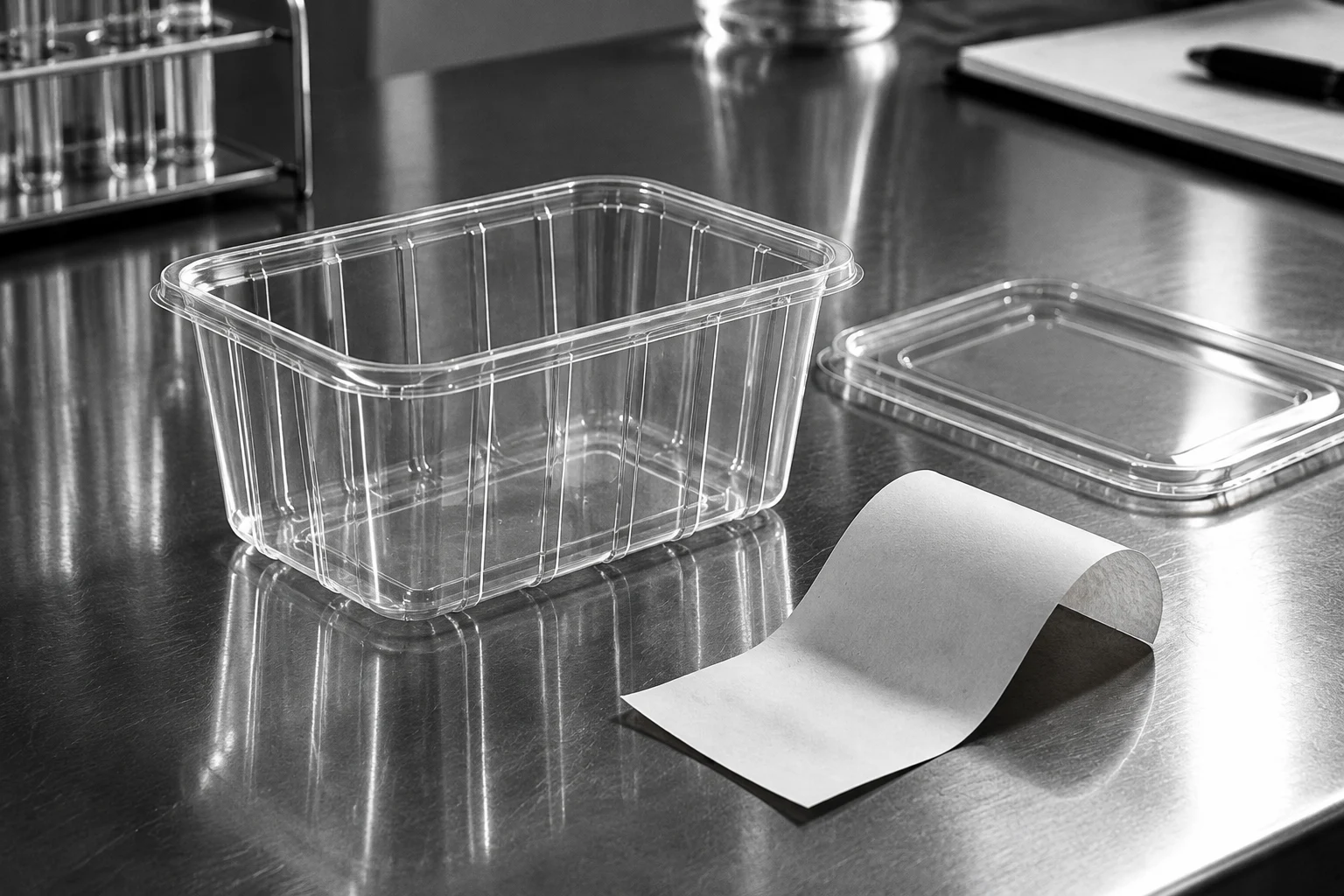
BPA-free is a powerful label because it gives a complicated materials question a two-word answer. Something people have heard about is absent. The product seems to move into a safer category. But the chemistry question begins where the label stops: what replaced it, how does that substitute behave, and what evidence supports the substitution?
Bisphenol A, or BPA, is used in some plastics and resins. Bisphenol S and bisphenol F — BPS and BPF — are related chemicals used in some applications as alternatives. The phrase BPA-free does not tell a reader whether either is present. It also does not demonstrate that a material has no other substances capable of biological activity. A claim about one ingredient is not a complete toxicological assessment. [1]
32
Studies in the 2015 systematic review
25
In vitro-only studies
7
In vivo studies — not human clinical trials
The review that changed the substitution conversation
In 2015, Johanna Rochester and Ashley Bolden published a systematic review in Environmental Health Perspectives examining the hormonal activity of BPS and BPF. Using a structured evidence-review approach, they included 32 studies: 25 conducted only in vitro and seven in vivo. This was a synthesis of laboratory research, not a trial following consumers who used BPA-free bottles. [1]
Across the included work, researchers observed estrogenic, antiestrogenic, androgenic and antiandrogenic activity, depending on the chemical and experimental system. The authors described the majority of the results as having potency in the same order of magnitude and similar action to BPA. That finding challenged the assumption that replacing BPA with a close analogue necessarily removes the relevant biological activity.
Figure 01 / Study data
What kind of evidence was in the review?
Cell-based and other laboratory assays; not whole-person health outcomes.
Whole-organism experimental evidence; not seven human clinical trials.
Scale: 0–32 studies
Counts from the 2015 review. These categories describe the included evidence, not disease incidence, risk or the present-day total number of publications.
Source: Rochester & Bolden, Environmental Health Perspectives (2015), DOI 10.1289/ehp.1408989. [1]
There is an equally important sentence that often disappears from summaries: this review does not establish that everyday use of a particular consumer product causes a human disease. A chemical can show activity in a cell assay without the assay identifying the exposure a person receives from a product. It can also generate a serious hazard signal that deserves investigation. Both statements can be true.
Similar names. Different chemical bridges.
The three substances share a bisphenol architecture, but the groups connecting their aromatic rings differ. BPA has an isopropylidene bridge, BPF a methylene bridge, and BPS a sulfonyl bridge. Those differences are not cosmetic. Chemical structure influences behavior, and small substitutions can change the interaction being measured. The following comparison summarizes the bridge chemistry; it is not a receptor-binding model. [1]
Figure 02 / Conceptual diagram
The bridge between two phenol rings
Reference 01
BPA
Isopropylidene bridge: –C(CH₃)₂–. Bisphenol A is the reference comparator in the review.
Reference 02
BPF
Methylene bridge: –CH₂–. A close analogue, not chemically identical to BPA.
Reference 03
BPS
Sulfonyl bridge: –S(=O)₂–. A different connecting group within the bisphenol family.
Simplified functional-group comparison, not complete molecular drawings or a ranking of safety. Differences in bridge chemistry do not alone establish potency, exposure or health risk.
Source: Chemical structures summarized in Rochester & Bolden (2015). [1]
A structural resemblance can motivate a biological hypothesis. It cannot demonstrate that two molecules bind to a receptor in the same way at the same dose. That requires measurements. Even then, one receptor endpoint is not the whole biological system.
Why 'more potent' is not one answer
The review reported descriptive summaries of in vitro estrogenic potency relative to BPA. For BPF, the mean relative potency was 1.07, with a reported range of 0.10–4.83. For BPS, the mean was 0.32, with a range of 0.01–0.90. The standard deviations were 1.20 and 0.28, respectively. These figures summarize heterogeneous assays, not human disease-risk ratios. [1]
| In vitro estrogenic comparison | Mean relative potency | Reported range |
|---|---|---|
| BPF compared with BPA | 1.07 (SD 1.20) | 0.10–4.83 |
| BPS compared with BPA | 0.32 (SD 0.28) | 0.01–0.90 |
These numbers are a useful correction to the claim that every BPA replacement is always more potent. In this specific summary, BPS had a lower mean relative estrogenic potency than BPA. Other endpoints and experimental settings can yield different relationships. There is no contradiction: potency is defined relative to what is measured.
The distance between a container and a human outcome
Figure 03 / Conceptual diagram
What a product-specific risk claim would need
- 01
Composition
Identify which chemicals are actually present in the material.
- 02
Migration
Measure what leaves that material under specified contact conditions.
- 03
Exposure and internal dose
Account for route, amount, absorption and metabolism.
- 04
Biological effect and health outcome
Evaluate relevant endpoints and human evidence, not just an isolated positive assay.
Conceptual evidence pathway, not a numerical exposure model. Product formulation and conditions cannot be inferred from a BPA-free label alone.
Source: Rochester & Bolden review and EFSA reassessment summary. [1, 2]
Temperature and contact time can matter in migration experiments, but the result depends on the specific material, chemical and test conditions. There is no scientifically defensible universal curve showing how much hormone-active material every bottle releases in a hot car. A chart without those details would look precise while saying less than a careful paragraph.
Thermal receipt papers are another application discussed in the substitution literature. Some have used bisphenols as color developers. That does not mean every receipt has the same composition, or that handling a receipt creates the same exposure as ingesting a chemical. Any quantitative comparison needs measured transfer, route and dose, not a list of everyday objects arranged from scary to scarier. [1]
The regulatory debate is not a laboratory result
EFSA's 2023 reassessment established a substantially lower tolerable daily intake for BPA, citing immune-system effects. This was an agency assessment of BPA, not a product-specific declaration that every BPA-free replacement is safe or unsafe. It addresses a different question from the BPS/BPF laboratory review. [2]
A tolerable daily intake is a risk-assessment benchmark built from an evidence base and uncertainty considerations. A cell-assay potency ratio is a different measurement. They cannot be placed on one chart as if they were interchangeable units.
When substitution becomes the research question
The concern often called regrettable substitution is straightforward: a substance attracts scrutiny, an alternative is introduced, and later evidence raises related questions about the replacement. But the term should not become a verdict issued before the evidence exists. Not all replacements are the same, and being structurally related is not itself proof of equal risk.
The 2015 review is best read as a challenge to a shortcut. It identified laboratory hormonal activity that deserved attention and warned against assuming that absence of BPA solves every relevant problem. It is also a historical review, not an exhaustive account of all research published since. The strongest conclusion is narrower than a viral warning — and more durable.
A better standard than a reassuring word
A genuinely informative materials claim would help answer three questions: what is present, what can migrate under intended conditions, and what evidence supports the assessment of that exposure. BPA-free answers only part of the first. It may be useful information, but it is not the end of the investigation.
The story is not that every replacement is a hidden catastrophe. It is that consumer labels often communicate less than people understandably read into them. Research earns its place by filling that gap with measurements and limitations — not by replacing a reassuring slogan with an equally unsupported frightening one.
Sources
- [1] Rochester JR, Bolden AL. Bisphenol S and F: A Systematic Review and Comparison of the Hormonal Activity of Bisphenol A Substitutes. Environmental Health Perspectives. 2015;123:643–650. https://pmc.ncbi.nlm.nih.gov/articles/PMC4492270/
- [2] EFSA. Bisphenol A in food is a health risk. Summary of the 2023 reassessment. https://www.efsa.europa.eu/en/news/bisphenol-food-health-risk